
Nissan Armada 2025-2026 Service and Repair Manual: Symptom Table
| Gauge indication | Refrigerant cycle | Probable cause | Corrective action |
|---|---|---|---|
Both high- and low-pressure sides are too high.
| The pressure returns to normal soon after sprinkling water on condenser. | Overfilled refrigerant. | Collect all refrigerant, evacuate refrigerant cycle again, and then refill it with the specified amount of refrigerant. |
| Air flow to condenser is insufficient. | Insufficient condenser cooling performance.
|
| |
| When A/C compressor is stopped, a high-pressure reading quickly drops by approximately 196 kPa (2 kg/cm2, 28 psi). It then gradually decreases. | Air mixed in refrigerant cycle. | Collect all refrigerant, evacuate refrigerant cycle again, and then refill it with the specified amount of refrigerant. | |
| Expansion valve opened too much (excessive flow of refrigerant). | Replace expansion valve.
| |
High-pressure side is excessively high and low-pressure side is too low.
| High-pressure pipe and upper side of condenser become hot, however, liquid tank does not become so hot. | Clogged or crushed high-pressure pipe located between A/C compressor and condenser. | Repair or replace the malfunctioning parts. |
High-pressure side is too low and low-pressure side is too high.
|
| Malfunction in A/C compressor system (insufficient A/C compressor pressure operation).
| Replace A/C compressor. Refer to Removal and Installation. |
Both high- and low-pressure sides are too low.
|
| Clogged expansion valve.
| Eliminate foreign material from expansion valve, or replace it.
|
| Malfunction in inner liquid tank (clogged strainer). | Replace condenser & liquid tank. Refer to Removal and Installation. | |
| Evaporator becomes frosted. | Clogged or crushed low-pressure pipe. | Repair or replace malfunctioning parts. | |
| Malfunction in intake air temperature sensor. | Check intake sensor system. Refer to Diagnosis Procedure. | ||
| There is a small temperature difference between the high and low pressure pipes for refrigerant cycle. |
|
| |
Low-pressure side sometimes becomes negative.
|
|
|
|
| Hunting in high-pressure side. | There is no temperature difference between high- and low-pressure sides. | Malfunctioning variable valve in A/C compressor. |
|
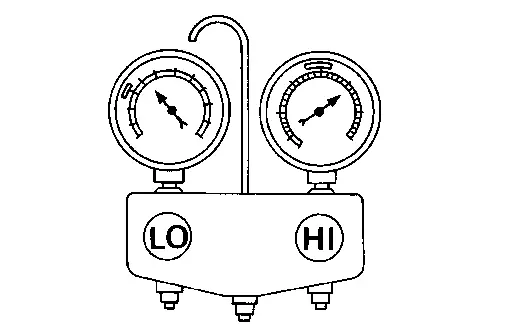
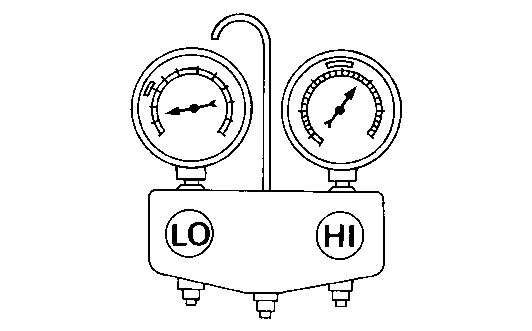
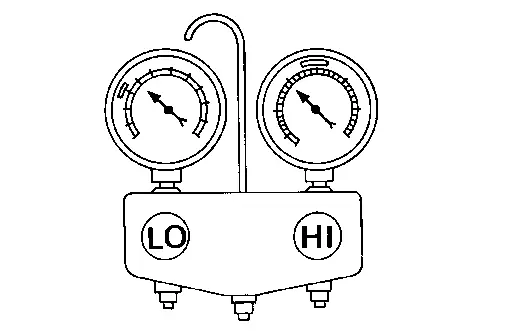
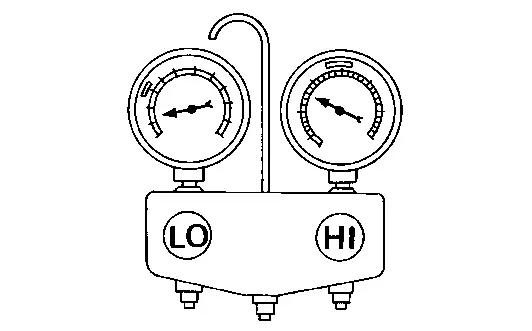
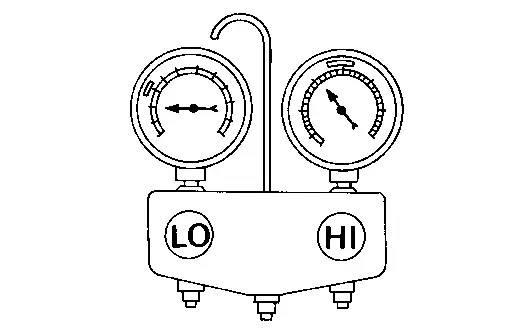
 Trouble Diagnosis For Unusual Pressure
Diagnose using a manifold gauge whenever system’s high and/or low side pressure(s) is/are unusual. The marker above the gauge scale in the following tables indicates the standard (usual) pressure ra ...
 Noise
Noise
...
Other materials:
Inspection
Open and close front door. Check that front door hinge and front door check link rotation portion moves smoothly.
Check front door hinge rotating part for lubrication condition. Apply body grease if necessary.
: Body grease
Check front door check link rotating part for lubrication condition. Ap ...
Diagnosis Procedure
CHECK TIRE PRESSURE SENSOR INSTALLATION
Check visually that tire pressure sensors are installed to each wheels correctly.
NOTE:
In the following case, tire pressure monitoring system (TPMS) does not function.
Tire pressure sensor(s) are not installed.
Tire pressure sensor(s) of other cars are inst ...
Exploded View
Rear final drive assembly Side oil seal : Vehicle front : Always replace after every disassembly. ...

0.0069