EVAP CANISTER : Leak Check
CAUTION:
-
Never use compressed air or a high pressure pump.
-
Never exceed 4.12 kPa (0.042 kg/cm2, 0.6 psi) of pressure in EVAP system.
 NOTE:
NOTE:
-
Never start engine.
-
Improper installation of EVAP service port adapter to the EVAP service port may cause a leak.
WITH CONSULT
To locate the EVAP leak, install EVAP service port adapter and pressure pump to EVAP service port. Refer to Hydraulic Layout.
NOTE:
If vacuum delay valve does not have EVAP service port, remove vacuum delay valve and install EVAP service port [commercial service tool: (Part No. 149393S500)] instead.
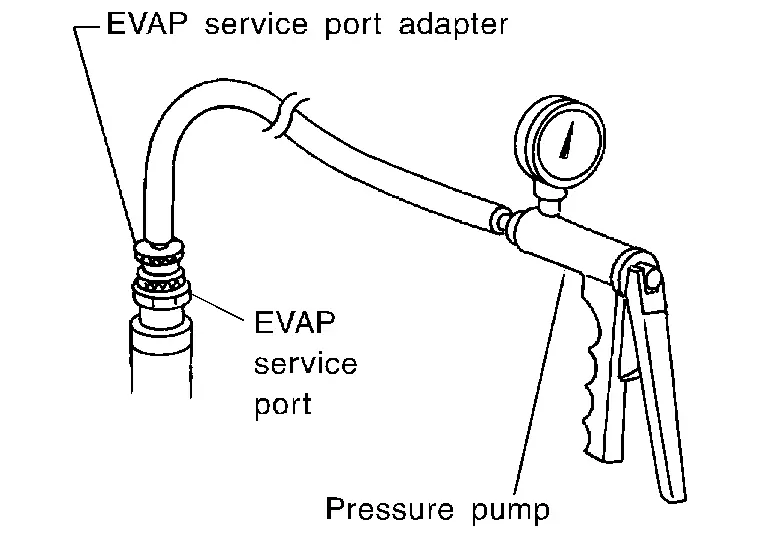
Ignition switch ON.
On CONSULT screen, select “ECM”>>“Work support”>>“EVAP SYSTEM CLOSE”.
Touch “START”. A bar graph (Pressure indicating display) will appear on the screen.
Apply positive pressure to the EVAP system until the pressure indicator reaches the middle of the bar graph.
Remove EVAP service port adapter and hose with pressure pump.
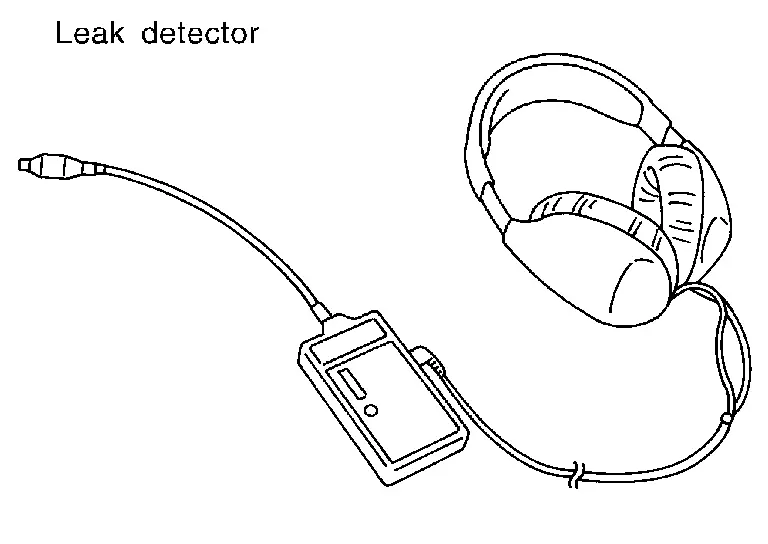
Locate the leak using a leak detector. Refer to System Description.
WITHOUT CONSULT
To locate the EVAP leak, install EVAP service port adapter and pressure pump to EVAP service port. Refer to Hydraulic Layout.
NOTE:
If vacuum delay valve does not have EVAP service port, remove vacuum delay valve and install EVAP service port [commercial service tool: (Part No. 149393S500)] instead.
Apply battery voltage between the terminals of EVAP canister vent control valve to make a closed EVAP system.
To locate the leak, deliver positive pressure to the EVAP system until pressure gauge points reach 1.38 to 2.76 kPa (0.014 to 0.028 kg/cm2, 0.2 to 0.4 psi).
Remove EVAP service port adapter and hose with pressure pump.
Locate the leak using a leak detector. Refer to System Description.
Connect pressure pump (A) to one of the ports of vacuum delay valve (1).
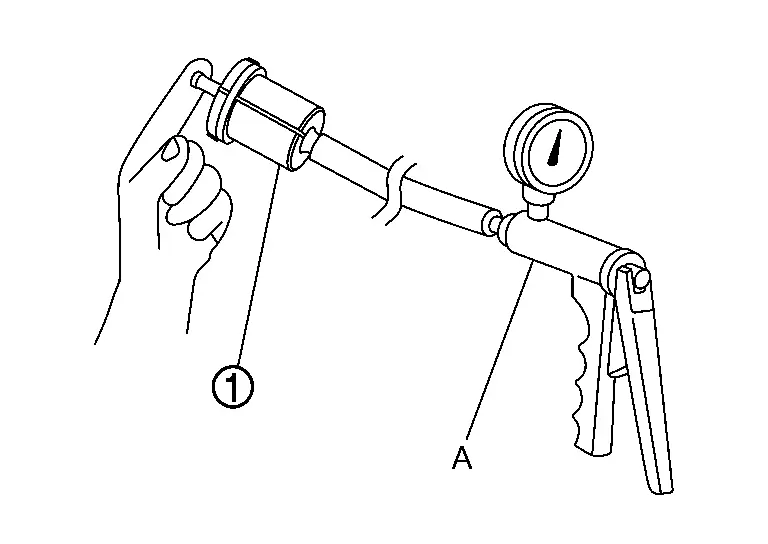
Close the other port of vacuum delay valve with a finger.
Apply pressure to the vacuum delay valve.
CAUTION:
Never apply pressure more than 4.12 kPa (0.042 kg/cm2, 0.6 psi).
Check vacuum delay valve for leakage.
Other materials
Heated seats
Basic information
WARNING
In the Nissan Armada, avoid using seat heaters if occupants are unable to
sense temperature changes or pain. Improper use may result in overheating and serious
injury.
CAUTION
Do not operate the heated seats in the Nissan Armada for extended periods
when not i ...
Passenger Side
Description
Passenger door does not lock/unlock using door lock and unlock switch.
Diagnosis Procedure
CHECK DOOR LOCK ACTUATOR
Check door lock actuator (passenger side).
Refer to Diagnosis Procedure.
Is the inspection result normal?
YES>>
GO TO 2.
NO>>
Repair or replace the malfunctio ...
Horn
Exploded View
Horn low
Horn high
Radiator core support
: vehicle front
: N·m (kg-m, ft-lb)
Removal & Installation
REMOVAL Horn HighRemove front bumper fascia assembly. Refer to Removal and Installation.
Disconnect harness connector .
Remove mounting bolt , and then remove hor ...