Work Procedure
FUEL PRESSURE RELEASE
FUEL PRESSURE RELEASE
-
Remove fuel pump fuse.
 NOTE:
NOTE:
-
For the fuse number, Refer to Wiring Diagram.
-
For the fuse arrangement.
-
-
Start engine.
-
After engine stalls, crank it two or three times to release all fuel pressure.
-
Ignition switch OFF.
-
Reinstall fuel pump fuse after servicing fuel system.
>>
INSPECTION END
LOW FUEL PRESSURE CHECK
CAUTION:
-
Before disconnecting fuel line, release fuel pressure from fuel line to eliminate danger.
-
The fuel hose connection method used when taking fuel pressure check must not be used for other purposes.
-
Be careful not to scratch or put debris around connection area when servicing, so that the quick connector maintains seal ability with O-rings inside.
-
Do not perform fuel pressure check with electrical systems operating (i.e. lights, rear defogger, A/C, etc.) Fuel pressure gauge may indicate false readings due to varying engine load and changes in manifold vacuum.
NOTE:
Prepare pans or saucers under the disconnected fuel line because the fuel may spill out. The fuel pressure cannot be completely released because this model does not have fuel return system.
FUEL PRESSURE CHECK
-
Release fuel pressure to zero.
-
Prepare fuel hose for fuel pressure check (B) and fuel tube adapter [SST: KV10120000 (-)] (D), then connect fuel pressure gauge (commercial service tool) (A).
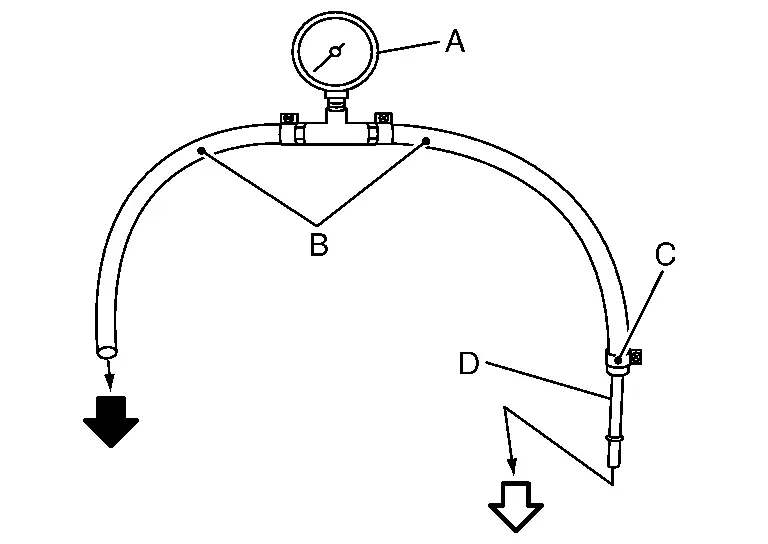
: To quick connector 
: To fuel tube (engine side) C : Clamp CAUTION:
-
Use suitable fuel hose for fuel pressure check (genuine NISSAN fuel hose without quick connector).
-
To avoid unnecessary force or tension to hose, use moderately long fuel hose for fuel pressure check.
-
Do not use the fuel hose for checking fuel pressure with damage or cracks on it.
-
Use Pressure Gauge to check fuel pressure.
-
-
Remove fuel hose.
CAUTION:
Do not twist or kink fuel hose because it is plastic hose.
-
Connect fuel hose for fuel pressure check (1) to fuel tube (engine side) (3) with clamp (2) as shown in the figure.
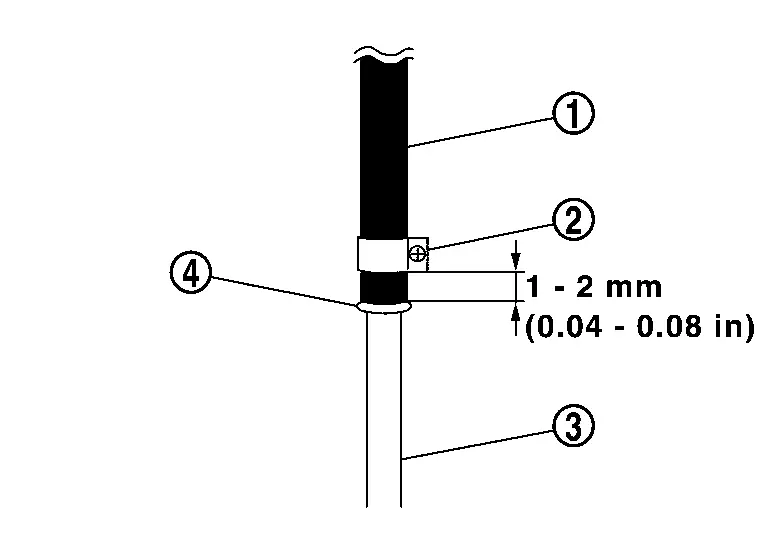
CAUTION:
-
Wipe off oil or dirt from hose insertion part using cloth moistened with gasoline.
-
Apply proper amount of gasoline between top of the high pressure fuel pump (3) and spool (4).
-
Insert fuel hose for fuel pressure check until it touches the spool on high pressure fuel pump.
-
Use NISSAN genuine hose clamp (part number: 16439 N4710 or 16439 40U00).
-
When reconnecting fuel line, always use new clamps.
-
Use a torque driver to tighten clamps.
Tightening torque: 1.0 - 1.5 N·m (0.1 - 0.15 kg-m, 9 - 13 in-lb) -
Install hose clamp to the position within 1 - 2 mm (0.04 - 0.08 in).
-
Make sure that clamp screw does not contact adjacent parts.
-
After connecting fuel hose for fuel pressure check, pull the hose with a force of approximately 98 N (10 kg, 22 lb) to confirm high pressure fuel pump does not come off.
-
-
Connect fuel tube adapter to quick connector.
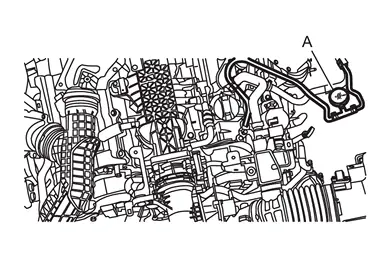
A :Fuel pressure gauge -
Ignition switch ON and check for fuel leakage.
-
Start engine and check for fuel leakage.
-
Stop the engine.
-
Ignition switch ON and read the indication of fuel pressure gauge.
CAUTION:
-
Do not perform fuel pressure check with system operating. Fuel pressure gauge may indicate false readings.
-
During fuel pressure check, confirm for fuel leakage from fuel connection every 3 minutes.
At ignition switch ON : Approximately 500 kPa (5.0 bar, 5.1 kg/cm2, 72.5 psi) -
Is the inspection result normal?
YES>>INSPECTION END
NO>>GO TO 2.
CHECK FUEL HOSES
Check the following.
-
Fuel hoses for clogging
-
Fuel filter for clogging
-
Low pressure fuel pump
-
Fuel pressure regulator for clogging
Is the inspection result normal?
YES>>Replace fuel pressure regulator.
NO>>Repair or replace error-detected parts.
HIGH FUEL PRESSURE CHECK
NOTE:
Since the fuel pressure gauge kit cannot be connected, follow the method shown below to check high fuel pressure.
WITH CONSULT
-
Start engine.
-
Check “Fuel pressure sensor voltage” in “Data monitor” mode with CONSULT.
Monitor Item Condition Values/Status Fuel pressure sensor voltage Idle 1.6V 2,000 rpm 1.5-2.1V
 WITHOUT CONSULT
-
Start the engine.
-
Check fuel rail pressure sensor signal voltage.
| + | − | Condition |
Value (Approx.) | |
|---|---|---|---|---|
| Fuel rail pressure sensor | ||||
| Connector | Terminal | |||
| F52 | 2 | Ground | Engine speed: idle | 1.6V |
| 2,000 rpm | 1.5-2.1V | |||
Other materials
4WD shift switch
Example
Select the appropriate 4WD mode in the Nissan Armada by shifting the 4WD
switch to AUTO, 4H, or 4L (if equipped), depending on current road and driving
conditions. This flexibility allows the Nissan Armada to adapt to both on-road
and off-road environments.
When AUTO mode ...
Towing safety
Trailer hitch
Your Nissan Armada is equipped with a factory-installed trailer towing package
designed to support reliable and safe towing operations.
This package includes a robust, frame-mounted receiver-type hitch that is engineered
to handle the maximum towing capacity of the Nissan Armada ...
Av Control Unit
Exploded View
Bracket RH
AV control unit
Bracket LH
: vehicle front
Removal & Installation
CAUTION:
Before replacing AV control unit, perform "ADDITIONAL SERVICE WHEN REPLACING AV CONTROL UNIT". For details, Refer to Work Procedure.ADDITIONAL SERVICE WHEN REPLACINGIf the following ...