
Nissan Armada 2025-2026 Service and Repair Manual: Precautions For Refrigerant System Service
GENERAL REFRIGERANT PRECAUTION
WARNING:
Never breathe A/C refrigerant and lubricant vapor or mist. Exposure may irritate eyes, nose and throat. Remove HFO-1234yf (R-1234yf) from the A/C system, using certified service equipment meeting requirements of SAE J2843 [HFO-1234yf (R-1234yf) Recovery/Recycling/Recharging Equipment for Flammable Refrigerants for Mobile Air Conditioning Systems] Ventilate work area before resuming service if accidental system discharge occurs. Additional health and safety information may be obtained from refrigerant and lubricant manufacturers.
Never release refrigerant into the air. Use approved recovery/recycling recharging equipment to capture the refrigerant each time an air conditioning system is discharged.
Wear always eye and hand protection (goggles and gloves) when working with any refrigerant or air conditioning system.
Never place the refrigerant containers and recovery/recycling equipment in a place where the temperature exceeds 40°C (104°F).
Never heat a refrigerant container with an open flame; Place the bottom of the container in a warm pail of water if container warming is required.
Never intentionally drop, puncture, or incinerate refrigerant containers.
Keep refrigerant away from open flames: poisonous gas is produced if refrigerant burns.
Refrigerant displaces oxygen, therefore be certain to work in well ventilated areas to prevent suffocation.
Never pressure test or leakage test HFO-1234yf (R-1234yf) service equipment and/or vehicle air conditioning systems with compressed air during repair. Some mixtures of air and HFO-1234yf (R-1234yf) have been shown to be combustible at elevated pressures. These mixtures, if ignited, may cause injury or property damage. Additional health and safety information may be obtained from refrigerant manufacturers.
WORKING WITH HFO-1234yf (R-1234YF)
CAUTION:
CFC-12 (R-12) or HFC-134a (R-134a) refrigerant and HFO-1234yf (R-1234yf) refrigerant are not compatible. A/C compressor malfunction is likely to occur if the refrigerants are mixed, refer to “CONTAMINATED REFRIGERANT� below. To determine the purity of HFO-1234yf (R-1234yf) in the vehicle and recovery tank, use Refrigerant recovery/recycling recharging equipment and Refrigerant Identifier.
Use only specified lubricant for the HFO-1234yf (R-1234yf) A/C system and HFO-1234yf (R-1234yf) components. If a compressor oil that does not meet the specifications is used, it will be worn and damaged due to poor lubrication, and the cooling and dehumidifying functions will be significantly reduced.
The specified HFO-1234yf (R-1234yf) lubricant rapidly absorbs moisture from the atmosphere. The following handling precautions must be observed:
Cap (seal) immediately the component to minimize the entry of moisture from the atmosphere when removing refrigerant components from a vehicle.
Never remove the caps (unseal) until just before connecting the components when installing refrigerant components to a vehicle. Connect all refrigerant loop components as quickly as possible to minimize the entry of moisture into system.
Use only the specified lubricant from a sealed container. Reseal immediately containers of lubricant. Lubricant becomes moisture saturated and should not be used without proper sealing.
Never allow lubricant to come in contact with styrene foam parts. Damage may result.
CONTAMINATED REFRIGERANT
Take appropriate steps shown below if a refrigerant other than pure HFO-1234yf (R-1234yf) is identified in a vehicle:
Explain to the customer that environmental regulations prohibit the release of contaminated refrigerant into the atmosphere.
Explain that recovery of the contaminated refrigerant could damage service equipment and refrigerant supply.
Suggest the customer return the vehicle to the location of previous service where the contamination may have occurred.
In case of repairing, recover the refrigerant using only dedicated equipment and containers. Never recover contaminated refrigerant into the existing service equipment. Contact a local refrigerant product retailer for available service if the facility does not have dedicated recovery equipment. This refrigerant must be disposed of in accordance with all federal and local regulations. In addition, replacement of all refrigerant system components on the vehicle is recommended.
The air conditioner warranty is void if the vehicle is within the warranty period. Please contact Nissan Customer Affairs for further assistance.
REFRIGERANT CONNECTION
WARNING:
Check that all refrigerant is discharged into the recycling equipment and the pressure in the system is less than atmospheric pressure. Then gradually loosen the discharge side hose fitting and remove it.
CAUTION:
Observe the following when replacing or cleaning refrigerant cycle components.
Store it in the same way at it is when mounted on the car when the A/C compressor is removed. Failure to do so will cause lubricant to enter the low-pressure chamber.
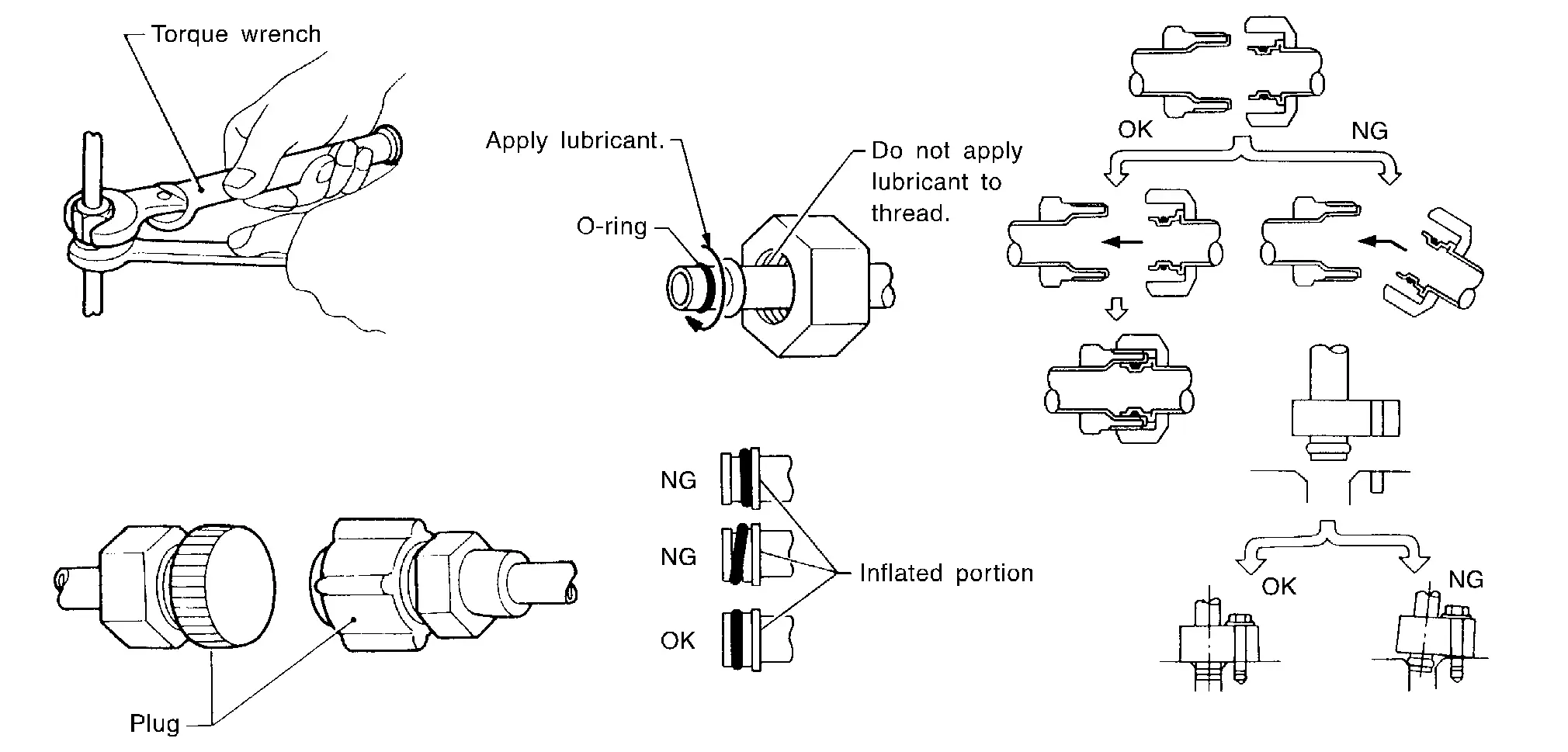
Use always a torque wrench and a back-up wrench when connecting tubes.
Plug immediately all openings to prevent entry of dust and moisture after disconnecting tubes.
Connect the pipes at the final stage of the operation when installing an air conditioner in the vehicle. Never remove the seal caps of pipes and other components until just before required for connection.
Allow components stored in cool areas to warm to working area temperature before removing seal caps. This prevents condensation from forming inside A/C components.
Remove thoroughly moisture from the refrigeration system before charging the refrigerant.
Replace always used O-rings.
Apply lubricant to circle of the O-rings shown in illustration when connecting tube. Be careful not to apply lubricant to threaded portion.
O-ring must be closely attached to the groove portion of tube.
Be careful not to damage O-ring and tube when replacing the O-ring.
Connect tube until a click can be heard. Then tighten the nut or bolt by hand. Check that the O-ring is installed to tube correctly.
Perform leakage test and make sure that there is no leakage from connections after connecting line. Disconnect that line and replace the O-ring when the refrigerant leaking point is found. Then tighten connections of seal seat to the specified torque.
A/C COMPRESSOR
CAUTION:
Plug all openings to prevent moisture and foreign matter from entering.
Store it in the same way at it is when mounted on the car when the A/C compressor is removed.
Follow “MAINTENANCE OF LUBRICANT LEVEL� exactly when replacing or repairing A/C compressor. Refer to Description.
Keep friction surfaces between clutch and pulley clean. Wipe it off by using a clean waste cloth moistened with thinner if the surface is contaminated with lubricant.
Turn the A/C compressor shaft by hand more than five turns in both directions after A/C compressor service operation. This distributes equally lubricant inside the A/C compressor. Let the engine idle and operate the A/C compressor for one hour after the A/C compressor is installed.
 Precaution for Electronic Air Suspension System
WARNING:
CAUTION:
Never expand and contract the air spring of shock absorber.
Never expand and contract the air spring.
Never let foreign materials entered into parts.
Always check for the air leakage ...
 Service Equipment
RECOVERY/RECYCLING RECHARGING EQUIPMENT
Be certain to follow the manufacturer’s instructions for machine operation and machine maintenance. Never introduce any refrigerant other than that specified ...
Other materials:
Removal and Installation
CAUTION:
Disconnect the battery negative terminal or remove power circuit fuse when performing the operation for preventing electric leakage. Refer to Precautions for Removing Battery Terminal.
REMOVAL
Remove front bumper fascia. Refer to following.
City model: Removal and Installation.
Off road mo ...
Exploded View
A/T assembly Oil pan gasket Overflow tube O-ring Oil pan Drain plug O-ring O-ring Refer to Removal and Installation. : Always replace after every disassembly. : Apply ATF ...
Front seats
Front power seat adjustment
The Nissan Armada front seats are equipped with advanced power adjustment features
designed for comfort and ergonomic support during long drives.
Operating tips:
The power seat motor includes an automatic overload protection system. If
adjustment stops unexpect ...

0.0057