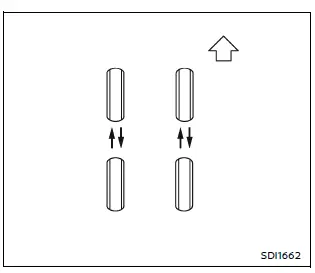
Tire rotation
To maintain optimal performance and extend tire life on your Nissan Armada, it is strongly recommended to rotate the tires at regular intervals of approximately 10,000 miles (16,000 km).
Consistent tire rotation helps ensure even tread wear, improves ride comfort, and contributes to safer handling characteristics of the Nissan Armada in various driving conditions.
As soon as possible, tighten the wheel nuts to the specified torque with a torque wrench.
Wheel nut tightening torque: 98 ft-lb (133 N·m)
The wheel nuts on your Nissan Armada must always be tightened to the correct specification. It is highly recommended to verify torque at every tire rotation interval to ensure safety and prevent wheel-related issues.
WARNING
- After rotating the tires on your Nissan Armada, always check and adjust the tire pressure to the recommended levels.
- Retighten the wheel nuts after driving approximately 600 miles (1,000 km), especially after tire rotation or replacement.
- Never include the temporary-use spare tire in the regular tire rotation process.
- For additional safety details, refer to the official Tire Safety Information in your Nissan Armada documentation.
- Do not rely on the Easy Fill Tire Alert system immediately after rotation.
Instead, use a reliable tire pressure gauge to set correct pressure based on the Tire and Loading Information label.
- After rotating the tires, the Easy Fill Tire Alert system may require
recalibration.
It is recommended to have the sensors reset and registered to their new positions by a qualified technician or a NISSAN dealer.
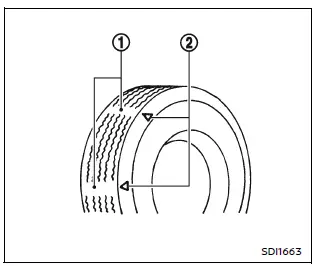
- Wear indicator
- Wear indicator location mark
Tire wear and damage
WARNING
- Regularly inspect tires on your Nissan Armada for signs of wear, cracks, bulges, or foreign objects embedded in the tread. If any of these issues are detected, the affected tires must be replaced immediately.
- Factory-installed tires on the Nissan Armada include built-in tread wear
indicators.
When these indicators become visible, it signals that the tire has reached its wear limit and should be replaced without delay.
- Tires naturally deteriorate over time due to aging and environmental
exposure.
It is recommended to have all tires, including the spare, inspected after six years of use, even if no visible damage is present, to avoid unexpected tire failure.
- Improper repair or handling of the spare tire can result in serious injury.
For safe servicing, always consult a NISSAN dealer when working with the spare tire of your Nissan Armada.
- Refer to official tire safety documentation for comprehensive guidelines regarding tire maintenance and replacement.
Replacing wheels and tires
When replacing tires on your Nissan Armada, always select tires that match the original specifications in terms of size, tread pattern, load capacity, and speed rating.
Using incorrect tires can negatively affect vehicle stability, braking performance, and overall safety. Maintaining manufacturer-recommended specifications ensures that your Nissan Armada continues to deliver reliable performance and driving confidence.
WARNING
- Using tires that are not specifically recommended for the Nissan Armada,
or mixing tires of different brands, constructions (bias, bias-belted, or radial),
or tread designs, can significantly compromise vehicle performance.
Such mismatches may negatively affect ride comfort, braking efficiency, steering response, operation of the VDC system, ground clearance, and even critical parameters such as speedometer accuracy, headlight alignment, and bumper height. These issues can increase the risk of accidents and may result in serious injury.
- For Two-Wheel Drive (2WD) Nissan Armada models, if only two tires are
being replaced, always install the new tires on the rear axle.
Installing new tires on the front axle while older tires remain on the rear can reduce stability and lead to loss of control under certain driving conditions.
- If wheels are replaced for any reason on your Nissan Armada, ensure that
the new wheels match the original offset specifications.
Incorrect wheel offset may lead to premature tire wear, degraded handling, and possible interference with braking components such as discs or drums, which can reduce braking performance and accelerate component wear.
- Because the spare tire on the Nissan Armada is not equipped with a TPMS
sensor, installing it will disable the system temporarily.
The low tire pressure warning light will flash for approximately one minute and then remain illuminated. After replacing the spare with a standard tire, the TPMS should be reset. It is recommended to visit a NISSAN dealer for proper servicing.
- Using tires that do not meet Nissan Armada factory specifications may interfere with correct TPMS functionality and compromise safety monitoring systems.
- The TPMS sensors are delicate components and may be damaged if handled improperly during tire service. Exercise caution when working with them.
- When installing new TPMS sensors, sensor ID registration may be required to ensure proper system operation. This procedure is best performed by a qualified technician or NISSAN dealer.
- Do not install valve stem caps that are not approved for use with the Nissan Armada. Incorrect caps may seize or damage the valve.
- Always ensure valve stem caps are securely fitted to prevent dirt, moisture, or debris from entering the valve and causing air leakage or malfunction.
- Never use wheels or tires that are damaged, bent, or deformed—even if
they have been repaired.
Such components may have hidden structural weaknesses and can fail unexpectedly, posing a serious safety risk.
- The use of retreaded tires on the Nissan Armada is not recommended, as they may not provide the same level of reliability and performance as new tires.
- For complete and detailed tire safety guidance, always refer to the official Tire Safety Information section provided in your vehicle documentation.
Four-Wheel Drive (4WD) models
CAUTION
- On 4WD Nissan Armada models, it is essential to use identical tires on
all four wheels.
This includes matching type, size, brand, construction, and tread pattern. Differences between front and rear tire circumferences can lead to excessive tire wear and may cause serious damage to drivetrain components such as the transmission, transfer case, and differential.
- Only use spare tires that are specifically approved for use with 4WD
Nissan Armada models.
Using an incorrect spare tire can disrupt drivetrain operation and may result in costly mechanical damage.
Maintaining proper tire consistency and using manufacturer-approved components is essential for preserving the performance, safety, and reliability of your Nissan Armada in all driving conditions.
If excessive or uneven tire wear is detected on your Nissan Armada, it is strongly recommended to replace all four tires simultaneously using tires that match in size, brand, construction, and tread pattern.
Maintaining uniform tires on your Nissan Armada ensures balanced handling, optimal traction, and proper operation of advanced safety systems. In addition, tire pressure and wheel alignment should be carefully inspected and corrected if necessary. For best results, it is advisable to have this service performed by a qualified technician or an authorized NISSAN dealer.
Wheel balance
Proper wheel balance is essential for maintaining smooth driving performance and extending tire life on your Nissan Armada.
Unbalanced wheels can lead to vibrations, uneven tire wear, and reduced handling stability. Even under normal driving conditions, wheels may gradually lose balance and should therefore be checked and corrected as needed.
Wheel balancing for the Nissan Armada should always be carried out with the wheels removed from the vehicle.
Attempting to balance wheels while they are still mounted (on-vehicle spin balancing) may cause mechanical damage and is not recommended.
For more comprehensive tire care guidelines, refer to the official tire safety information included in your Nissan Armada documentation.
Spare tire
The spare tire on the Nissan Armada is not equipped with a Tire Pressure Monitoring System (TPMS) sensor. As a result, when a spare tire is installed—particularly a TEMPORARY USE ONLY spare—the TPMS will be temporarily disabled.
Spare tire (FULL-SIZE TEMPORARY USE ONLY spare tire) (if so equipped):
When using the full-size temporary spare tire on your Nissan Armada, follow these precautions carefully to prevent vehicle damage and ensure safe operation.
WARNING
- The full-size temporary spare tire is intended strictly for emergency
use on your Nissan Armada.
It should be replaced with a standard tire as soon as possible to avoid potential damage to the drivetrain or differential.
- Drive cautiously when the spare tire is installed.
Avoid sudden steering inputs, aggressive braking, and high-speed driving, as overall vehicle stability and traction—especially in wet or snowy conditions—may be reduced.
- When operating your Nissan Armada with a spare tire installed, certain
systems may not function as intended.
- Tire Pressure Monitoring System (TPMS)
- Vehicle Dynamic Control (VDC) system
- Regularly check the inflation pressure of the spare tire.
Ensure it is maintained at the recommended pressure specified on the Tire and Loading Information label to guarantee safe use.
- Do not exceed a speed of 70 MPH (112 km/h) when driving your Nissan Armada with the spare tire installed.
- When driving on snow or ice-covered roads, install the spare tire on
the front wheels and move the original tires to the rear (drive wheels).
In such conditions, tire chains should only be installed on the rear original tires for maximum traction and safety.
- Never use the Nissan Armada spare tire on another vehicle, as compatibility and safety cannot be guaranteed.
- Do not use more than one spare tire at the same time, as this may severely affect vehicle handling and stability.
CAUTION
Do not install tire chains on the spare tire of your Nissan Armada.
Tire chains are not designed to fit spare tires correctly and may cause damage to suspension components, body parts, or the tire itself.
Following these guidelines will help ensure that your Nissan Armada maintains safe driving characteristics even in emergency situations involving tire replacement.
Other materials
Ventilators
Center ventilators
The Nissan Armada center ventilators can be opened, closed, and adjusted by moving
the central control knob, allowing precise airflow direction and enhanced cabin
comfort.
Side ventilators
Side ventilators in the Nissan Armada provide additional airflow customiz ...
Body Side Welt
Removal and Installation
CAUTION:
Never excessively pull body side welt.
Never damage the body panel.
REMOVALFront Body Side WeltPull the mounting part inside the vehicle to the outside of the vehicle, and then remove front body side welt. CAUTION:
Remove the headlining portion of front body ...
Precautions
Precaution for Supplemental Restraint System (SRS) "AIR BAG" and "SEAT BELT PRE-TENSIONER"
The Supplemental Restraint System such as “AIR BAG� and “SEAT BELT PRE-TENSIONER�, used along with a front seat belt, helps to reduce the risk or severity of injury to the driver and front passenger fo ...