Inspection
LEVEL
-
Check if the reservoir tank engine coolant level is within the “MIN” to “MAX” when the engine is cool.
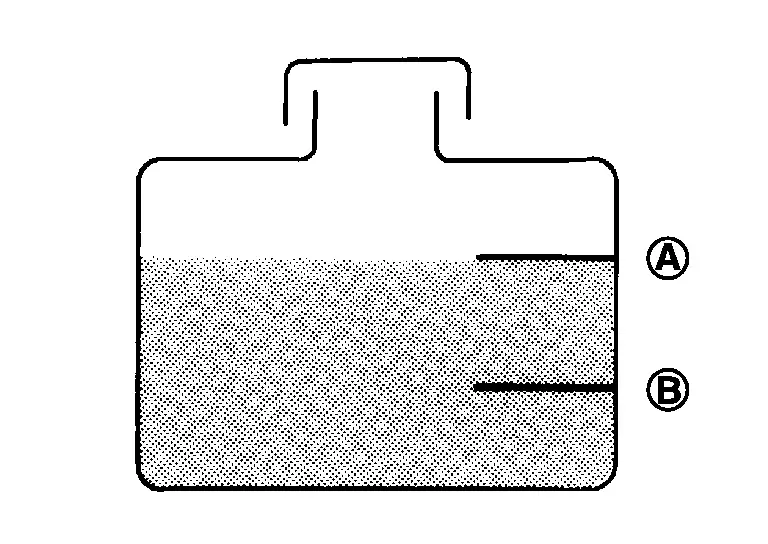

: MAX 
: MIN -
Adjust the engine coolant level if necessary.
WARNING:
Never remove reservoir tank cap when engine is hot.
CAUTION:
Refill Genuine NISSAN Long Life Antifreeze/Coolant (blue) or equivalent in its quality mixed with water (distilled or demineralized).Refer to Anti-Freeze Coolant Mixture Ratio..
LEAKAGE
 NOTE:
NOTE:
The sealing surface between the water pump body and the shaft is lubricated by engine coolant.
A small amount of engine coolant is discharged from the lubrication surface during normal operation and may be found as a coolant residue on the plug, bleed hole, or bottom of water pump assembly.
In case of coolant residue is found on the water pump assembly, check the water pump leakage. Refer to WATER PUMP : Inspection.
-
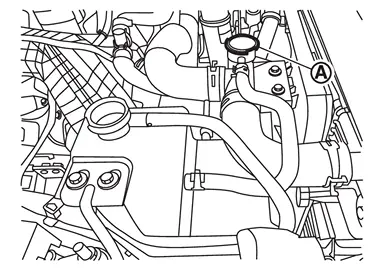
Open the reservoir tank cap.
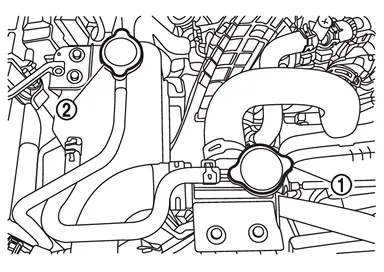

: Radiator cap 
: Reservoir tank cap -
To check for leakage, apply pressure to the cooling system with the radiator cap tester (commercial service tool) (A) and radiator cap tester adapter (commercial service tool) (B).
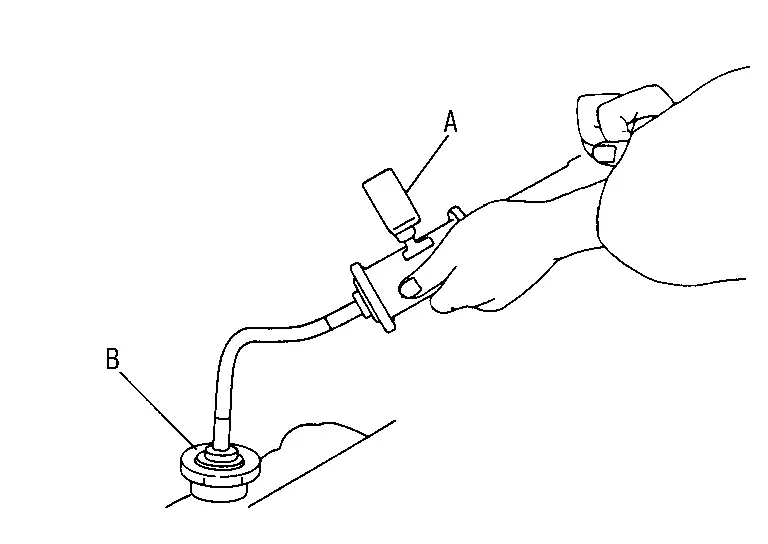
Testing pressure : Refer to RADIATOR : Service Data. WARNING:
Never remove radiator cap and reservoir tank cap when engine is hot. Serious burns could occur from high-pressure engine coolant escaping from engine cooling system.
CAUTION:
Higher test pressure than specified may cause radiator damage.
NOTE:
In a case that engine coolant decreases, fill radiator with engine coolant.
-
If anything is found, repair or replace damaged parts.
Draining
WARNING:
-
Jacking up or lift up the vehicle may the vehicle height to go down which cause a personal injury and/or damage to the air suspension component parts. Refer to Precaution for when Jacking and Lifting Up the vehicle with Electronic Air Suspension System.
WARNING:
-
To avoid being scalded, never change engine coolant when the engine is hot.
-
Wrap a thick cloth around reservoir tank cap and carefully remove reservoir tank cap.
First, turn reservoir tank cap a quarter of a turn to release built up pressure. Then turn reservoir tank cap all the way.
-
Never spill engine coolant on drive belt.
Connect drain hose.
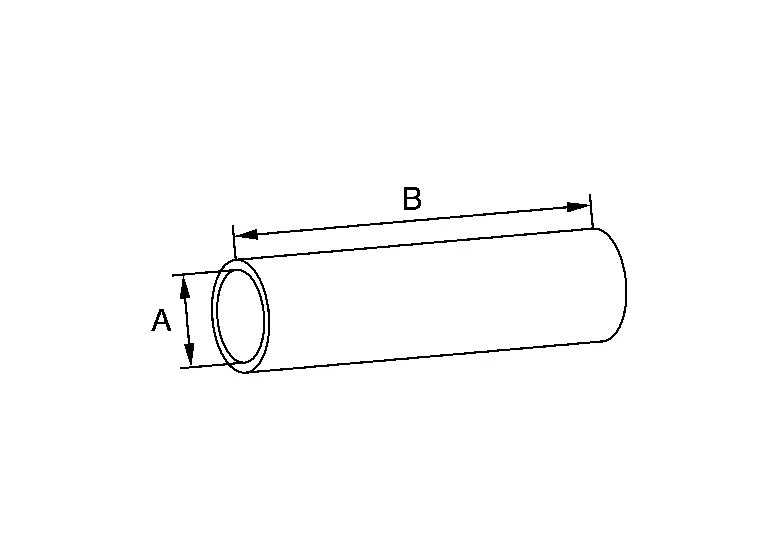
NOTE:
Use a general-purpose hose with the dimensions shown in the figure.
| A | : φ 5.5 – 6.0 mm (0.217 - 0.236 in) |
| B | : 600 mm (23.62 in) or more |
Open radiator drain cock at the bottom of radiator, and then remove radiator cap and reservoir tank cap.
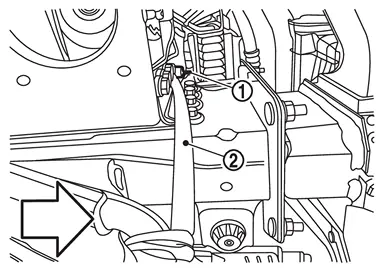
 |
: Drain hose |
| : vehicle front |
When draining all of engine coolant in the system, open water drain plugs on cylinder block. Refer to Setting.
Remove reservoir tank if necessary, and drain engine coolant and clean reservoir tank before installing.
Check drained engine coolant for contaminants such as rust, corrosion or discoloration.
If contaminated, flush the engine cooling system. Refer to ENGINE COOLANT : Flushing.
Disconnect drain hose.
Refilling
WARNING:
-
Jacking up or lift up the vehicle may the vehicle height to go down which cause a personal injury and/or damage to the air suspension component parts. Refer to Precaution for when Jacking and Lifting Up the vehicle with Electronic Air Suspension System.
REFILLING (FOR COOLANT REFILL TOOL)
WARNING:
If the multi-way control valve is not fully open, engine over heat risk may increase when driving caused by air remaining(LLC is not fully filled) in the coolant hose.
CAUTION:
-
Do not put additive such as waterleak preventive, since it may cause cooling waterway clogging.
-
When refilling use Genuine NISSAN Long Life Antifreeze/Coolant (blue) or equivalent in its quality mixed with water (distilled or demineralized). Refer to Fluids and Lubricants.
-
Check the tightening condition of hose clamp, drain plug, and others.
-
Do not start engine when reservoir tank does not contain engine coolant.
-
Electric water pump may be activated under the status of ignition switch ON. To prevent damage, electric water pump must not be activated when engine coolant is insufficient.
-
Close drain plug.
Set the coolant refill tool [SST:KV991J0070(NI-45695-A)] to the reservoir tank.
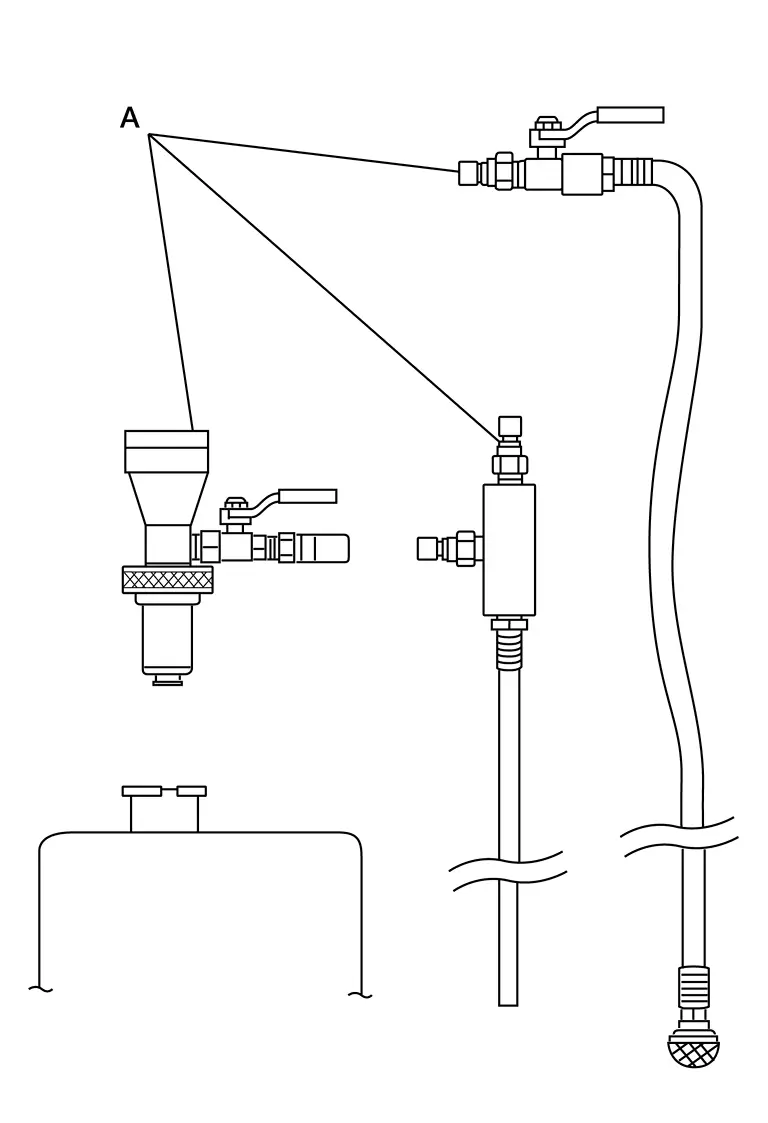
Set vacuum water injection machine [commercial tool: capable negative pressure is 90 kPa (675 mmHg, 27 inHg) or more] to the reservoir tank.
Perform water injection according to each instruction manual.
Confirm that the value of the vacuum gauge is about 96 kPa (720 mmHg, 28 inHg) and start the refilling of engine coolant
CAUTION:
Internal pressure applied to the radiator when water is injected must be 196kPa (1470 mmHg, 58 inHg) or less.
Refill engine coolant up to radiator to specified level.
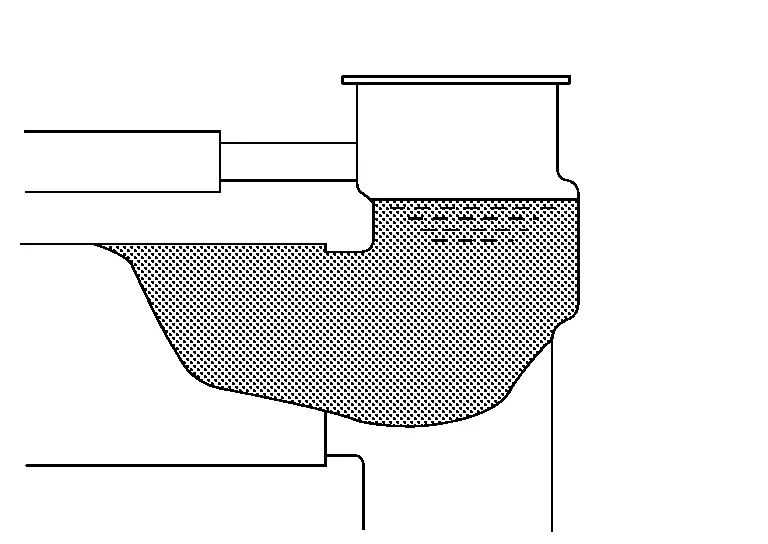
Refill engine coolant up to "MAX" line level of reservoir tank and tighten the cap.
|
: MAX |
|
: MIN |
Start the engine and warm it up.
CAUTION:
Watch water temperature gauge so as not to overheat engine.
Stop the engine and cool down.
If necessary, refill radiator up to filler neck with engine coolant.
CAUTION:
Never adhere the engine coolant to electronic equipments (alternator etc.).
Refill reservoir tank to “MAX” level line with engine coolant.
|
: MAX |
|
: MIN |
CAUTION:
Never adhere the engine coolant to electronic equipments (alternator etc.).
REFILLING(EXCEPT FOR COOLANT REFILL TOOL)
WARNING:
If the multi-way control valve is not fully open, engine over heat risk may increase when driving caused by air remaining(LLC is not fully filled) in the coolant hose.
CAUTION:
-
Do not put additive such as waterleak preventive, since it may cause cooling waterway clogging.
-
When refilling use Genuine NISSAN Long Life Antifreeze/Coolant (blue) or equivalent in its quality mixed with water (distilled or demineralized). Refer to Fluids and Lubricants.
-
Check the tightening condition of hose clamp, drain plug, and others.
-
Do not start engine when reservoir tank does not contain engine coolant.
-
Electric water pump may be activated under the status of ignition switch ON. To prevent damage, electric water pump must not be activated when engine coolant is insufficient.
-
Close drain plug.
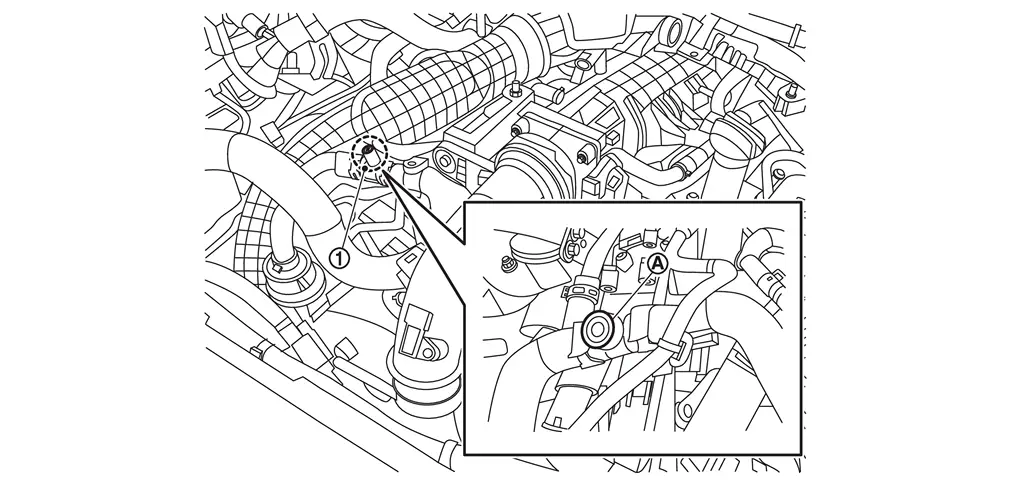
Remove cap  of the front heater outlet pipe assembly .
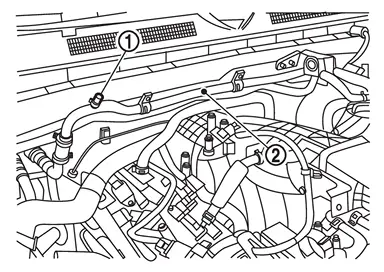
Remove drain plug of the connector .
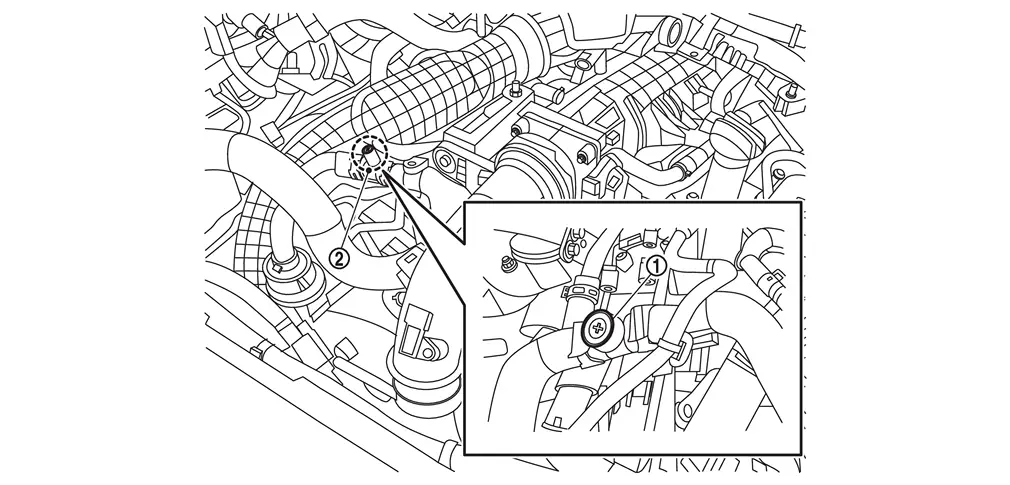
Pour engine coolant from the part of the radiator pipe assembly.
When the engine coolant comes out from the part of the connector , stop water injection.
Pour coolant slowly in to the reservoir tank at of less than 3 ℓ (3-1/8 US qt, 2-5/8 lmp qt) a minute to allow air in system to escape.
| Engine coolant capacity | Refer to ENGINE COOLANT : Service Data. |
| (With reservoir tank at “MAX” level) |
Install reservoir tank cap.
Pour coolant slowly in to the radiator pipe assembly at of less than 3 ℓ (3-1/8 US qt, 2-5/8 lmp qt) a minute to allow air in system to escape.
Install radiator cap.
Install cap of the front heater outlet pipe assembly .
Warm up engine until opening thermostat. Standard for warming-up time is approximately 10 minutes at 3,000 rpm.
-
Check thermostat opening condition by touching radiator hose (lower) to see a flow of warm water.
CAUTION:
Watch water temperature gauge so as not to overheat engine.
Stop the engine and cool down to less than approximately 50°C (122°F).
-
Cool down using fan to reduce the time.
-
Check the engine coolant level. If the level is low, refill with reservoir tank to “MAX” level line with engine coolant and repeat the steps from Step 11.
: MAX : MIN CAUTION:
Never adhere the engine coolant to electronic equipments (alternator etc.).
Check flow noise, according to the following steps.
CAUTION:
To check flow noise, turn OFF the radio and close the windows, doors, and the hood.
Allow the engine to become cold [approximately 50°C (122°F) or less]. Start the engine, maintain 1000 rpm for approximately 30 seconds, and increase the engine speed from 1000 to 3000 rpm. Repeat this cycle three times. Check that flow noise can be heard from the heater core during the Step b operation. If flow noise can be heard, repeat from Step 11 of Refilling to Step c of Flow Noise Verification Method. Check that the reservoir tank cap is tightened.Flushing
WARNING:
-
Jacking up or lift up the vehicle may the vehicle height to go down which cause a personal injury and/or damage to the air suspension component parts. Refer to Precaution for when Jacking and Lifting Up the vehicle with Electronic Air Suspension System.
Install reservoir tank if removed, and radiator drain plug.
CAUTION:
Be sure to clean drain plug and install with new O-ring.
| Tightening torque | Refer to RADIATOR : Exploded View. |
If water drain plug on cylinder block is removed, close and tighten it. Refer to Setting.
Fill radiator and reservoir tank with water and reinstall radiator cap and reservoir tank cap. Refer to ENGINE COOLANT : Refilling.
Run the engine and warm it up to normal operating temperature.
Rev the engine two or three times under no-load.
Stop the engine and wait until it cools down.
Drain water from the system. Refer to ENGINE COOLANT : Draining.
Repeat steps 1 through 6 until clear water begins to drain from radiator.
Check that the radiator cap and reservoir tank cap is tightened.
Other materials
Precautions
Precautions for Removing Battery Terminal
When disconnecting the 12V battery terminal, turn off the ACC power before disconnecting the 12V battery terminal, observing “How to disconnect 12V battery terminal” described below.
NOTE:
Some ECUs operate for a certain fixed time even after ignit ...
Steering System Service Data and Specifications
Steering Wheel
Item Standard
Steering wheel axial end play
0 mm (0 in)
Steering wheel play on the outer circumference
0 – 35 mm (0 – 1.38 in)
Steering wheel turning force
34 N (3.5 kgf, 7.6 lbf) or less
Steering Angle
WITHOUT DINAMIC DIGITAL SUSPENSION AND ELECTRONIC AIR SUSPE ...
Front Door Check Link
Removal and Installation
REMOVALFully close front door glass.
Remove front door woofer. Refer to Removal & Installation.
Remove front door check link mounting bolt of vehicle body side.
Remove front door check link mounting bolts of front door panel, and then take front door check link out from ...