
Nissan Armada 2025-2026 Service and Repair Manual: Key Points in Actual Repair Work
CAUTION:
Illustration shows a badly damaged side member for clarity. Badly damaged or kinked side rails must always be replaced.
(1) STRETCHING SHRUNK PORTIONS
The repair of a bent closed cross-sectional structure, such as a side member, is done by clamping the surface of the bent-in side and pulling. The pulling direction should be such that force is applied in the direction of an imaginary straight line extending through the original position of the part.
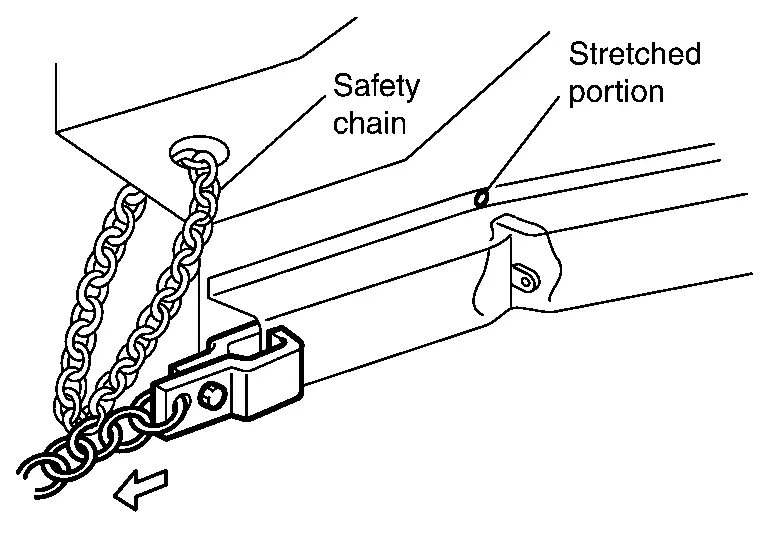
Sometimes a load of approximately 5,000 kg (11,025 lb) is applied during repair work. Accordingly, the clamp must be tightened securely. Be sure to use safety chain.
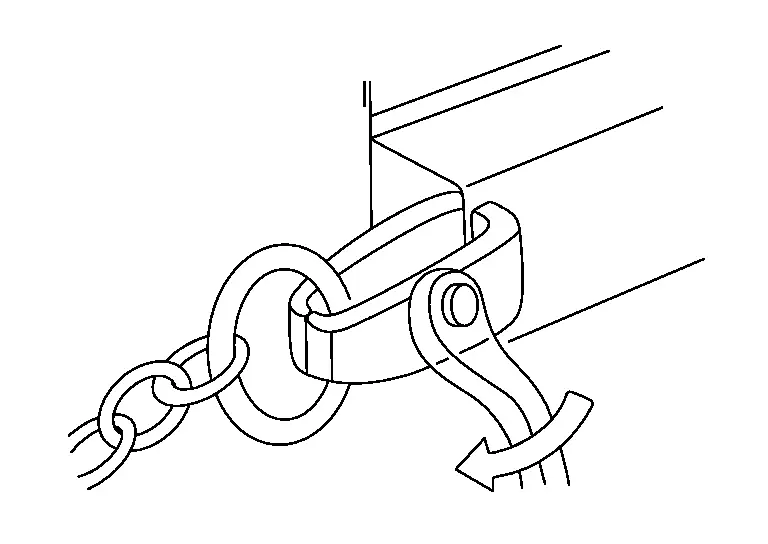
(2) GRADUAL PULL
Pull step by step.
The damaged portion may be work hardened.
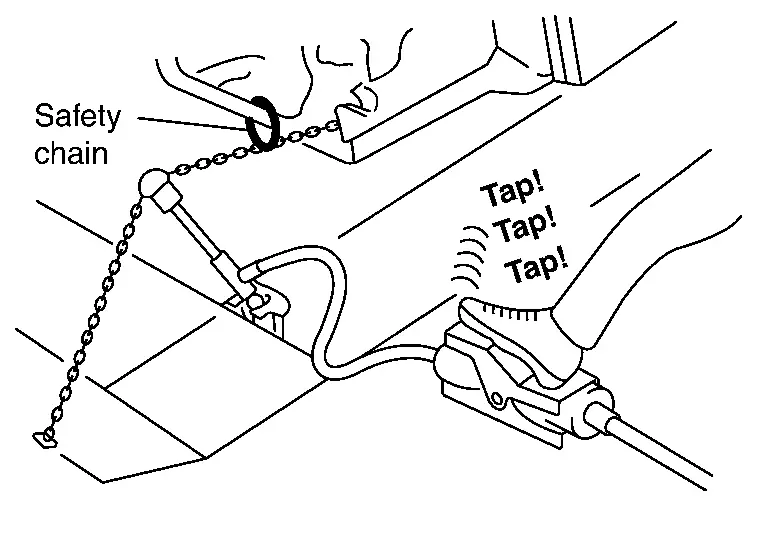
Pulling all at once may cause cracking.
Reduce the hardness of the work-hardened portion.
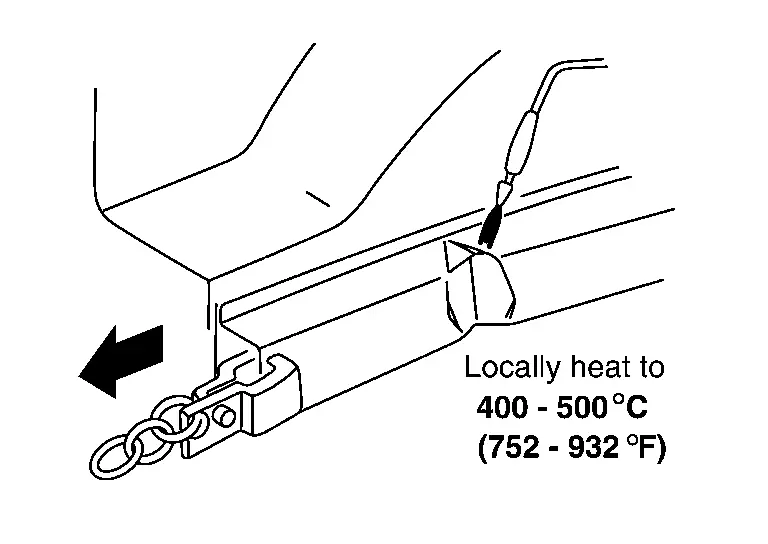
Locally heat the panel to 400°C - 500°C (752°C - 932°F) to the extent that the panel is not colored. Do not heat above 700°C (1,292°F), or strength will be reduced. Do not raise to a temperature of more than 550°C (1,020°F) for HSS parts.
(3) CONSIDER SPRING-BACK
When pulling force is applied to a panel, spring-back is generated by the residual stress.
Proper amount of pull
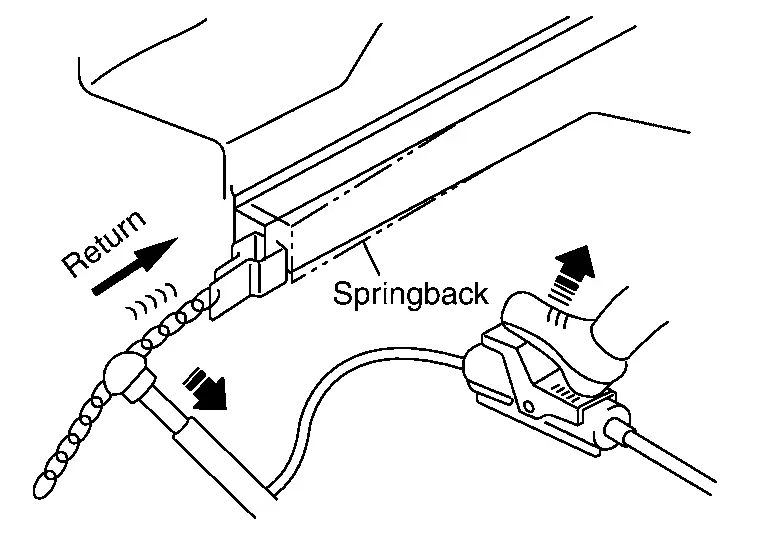
Pull 2 mm - 3 mm (0.08 in - 0.12 in) more than the required dimension. Adjust the amount of pull corresponding to the spring-back.
Use of hammer
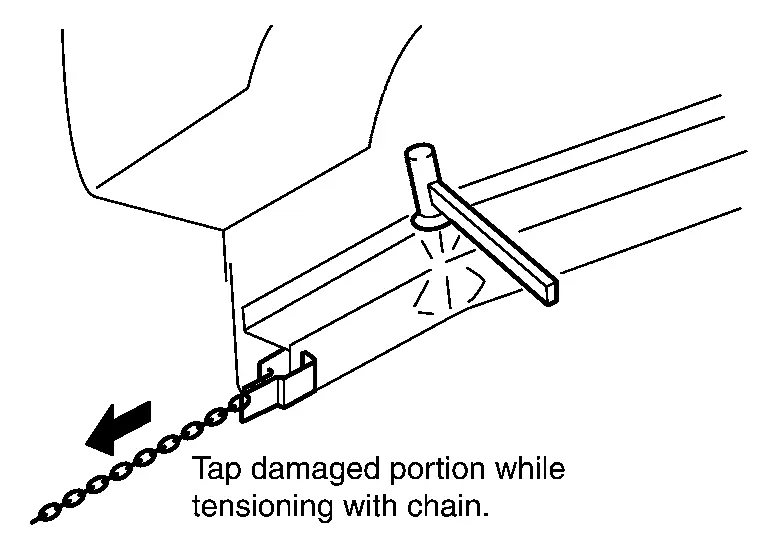
Residual stress caused by kinetic energy of the collision can be removed by hammering.
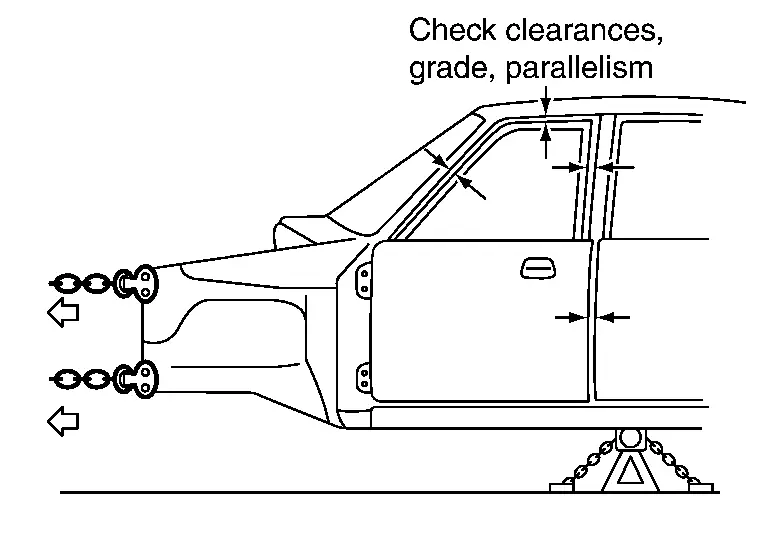
(4) DETERMINING PROPER AMOUNT OF PULL BY OBSERVING DOOR FIT
The proper amount of pull can be determined by observing the clearance at the door or trunk lid.
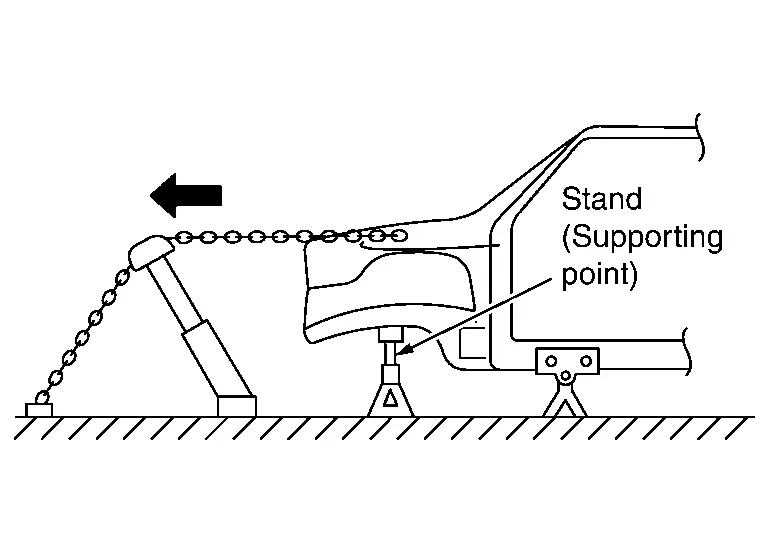
(5) PULLING UPPER PORTIONS FROM UNDERBODY CLAMP
Note that if there is distance between the pulling point and the underbody clamp, as indicated by (A) in the figure, a moment of rotation is produced.
This may cause secondary damage to the clamped portion.
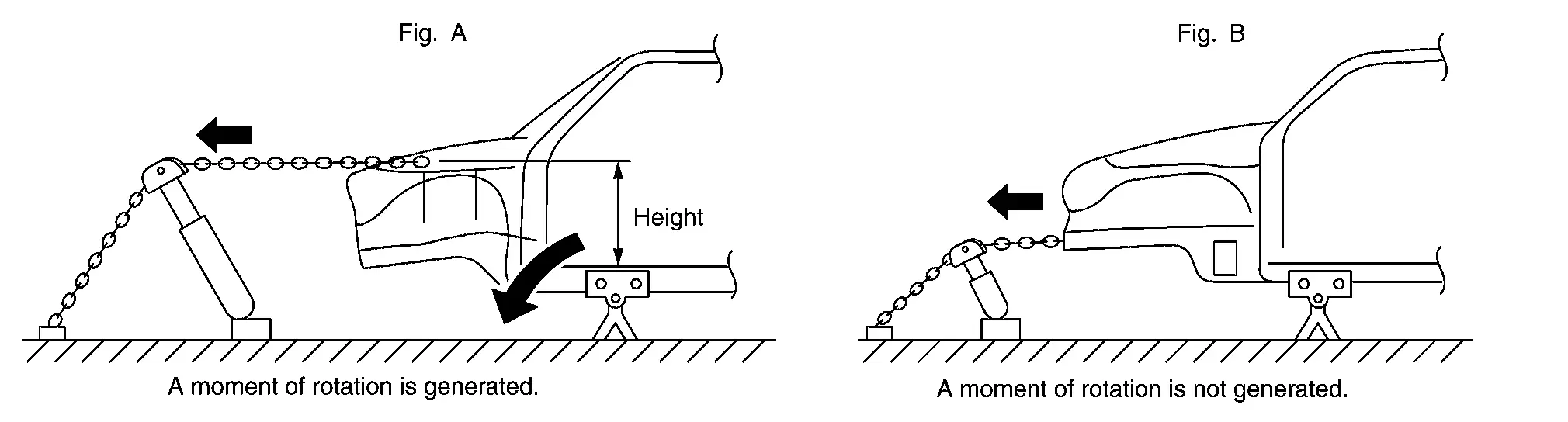
Provide a supporting point under the side member to prevent generation of this moment of rotation.
(6) ADDITIONAL ANCHORING
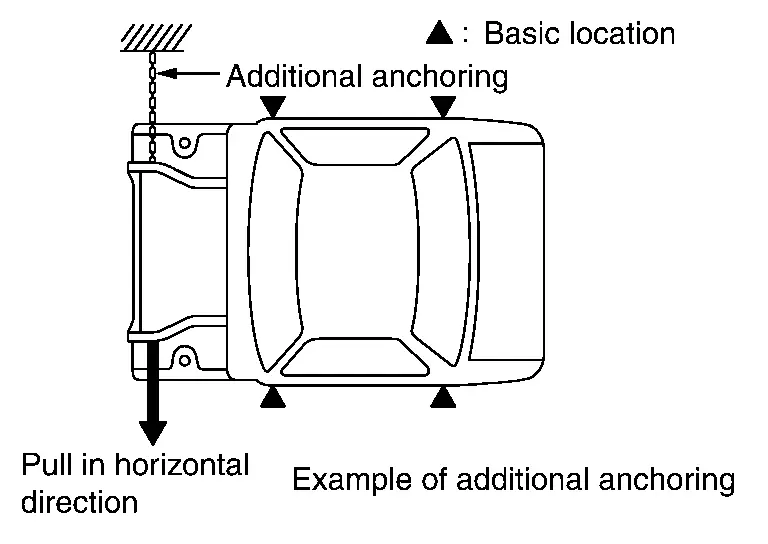
Pulling work must be performed with care taken not to damage the anchoring points or undamaged area of the body. If area not targeted for repair is affected by the excessive pulling force or the direction of pulling, additional anchoring points need to be provided to protect undamaged areas. Side sills are strong enough against longitudinal force, however, they are easily damaged by downward or lateral force. For this reason, additional anchoring should be provided by supporting side members with the port power, or attaching a clamp and chain.
(7) PURPOSE OF BODY ALIGNMENT
This operation is necessary to obtain correct alignment of parts to be used again. Therefore, the damage caused by propagated impact is recovered by pulling out the first input point.
 Repair Sequence
In general, no single bend or twist is produced in a collision. Body deformation results from a combination of bending and twisting and other types of damage.
Repair should start where the damage is m ...
 Replacement of Panel
Panel replacement work includes replacement of the front fenders and hood which are installed by bolts, and replacement of rear fenders and the roof which are welded. This section explains panel repla ...
Other materials:
Body Sealing
WARNING:
The following figure shows the areas that are sealed at the factory. Sealant that is applied to these areas should be smooth and free from cuts or gaps. Care should be taken not to apply an excess amount of sealant and not to allow other unaffected parts to come into contact with the sealan ...
Anchoring with Frame Attachments
A difference between the frame anchoring and the uni-body anchoring is that the frame itself is held down. (For the basic anchoring methods for uni-bodies, refer to Securing the Vehicle.)
Frame straightening equipment makers offer the attachments for frame anchoring including those intended for any ...
Lower Anchors and Tethers for CHildren System (LATCH)
LATCH system lower anchor locations - models with 2nd row captain's seats
LATCH system lower anchor locations - models with 2nd row bench seat
Lower Anchors and Tethers for CHildren System (LATCH)
Basic information
The Nissan Armada is equipped with a dedicated child safety anchoring ...

0.0067