Basic information
The engine cooling system of the Nissan Armada is factory-filled with a precisely balanced mixture consisting of 50% Genuine NISSAN Long Life Antifreeze/Coolant (blue) and 50% water. This formulation ensures reliable year-round protection against freezing, overheating, and corrosion.
This advanced coolant used in the Nissan Armada includes corrosion inhibitors designed to protect internal engine components, making additional cooling system additives unnecessary under normal conditions.
Maintaining the correct coolant composition is essential for preserving engine efficiency, preventing overheating, and extending the service life of the Nissan Armada powertrain.
WARNING
- Never remove the radiator cap or coolant reservoir cap while the Nissan
Armada engine is hot. Allow sufficient time for the engine and cooling system
to cool down completely.
Opening the system under pressure may cause hot coolant to spray out, resulting in serious burns or injury.
- The radiator in the Nissan Armada uses a pressurized cap. Always use a genuine NISSAN radiator cap to ensure proper system operation and to prevent potential engine damage.
CAUTION
- Do not use cooling system additives such as sealants or stop-leak products
in the Nissan Armada.
These substances may clog passages within the cooling system and lead to serious damage to the engine, transmission, or radiator components.
- When topping up or replacing coolant in your Nissan Armada, use only
Genuine NISSAN Long Life Antifreeze/Coolant (blue) or a fully compatible equivalent.
This coolant is pre-diluted to provide freeze protection down to −34°F (−37°C). If operating in extremely cold climates, additional concentrate may be added according to manufacturer instructions.
If using an alternative coolant, carefully follow the product guidelines to ensure equivalent protection. Using incorrect coolant types may compromise the Nissan Armada cooling system and lead to costly repairs.
- The factory-filled coolant in the Nissan Armada is designed to last up
to 105,000 miles (168,000 km) or approximately 7 years under normal driving
conditions.
Mixing different coolant types, including green antifreeze or non-distilled water, may significantly reduce its lifespan and effectiveness.
Refer to the maintenance schedule for detailed service intervals and always maintain the correct coolant quality for optimal Nissan Armada performance.
Regular inspection of coolant levels and components in the Nissan Armada engine bay helps ensure reliable operation and prevents overheating issues, especially during demanding driving conditions.
Checking engine coolant level
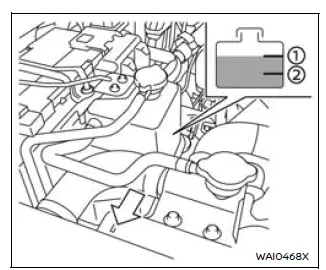
For optimal performance and reliability of your Nissan Armada, always check the engine coolant level when the engine is completely cold.
Inspect the coolant level in the reservoir tank. If the level is below the MIN 2 mark, carefully open the reservoir cap and add the appropriate coolant until it reaches the MAX 1 level.
If the reservoir tank is empty, it is important to also check the coolant level directly in the radiator. When the engine is cold, remove the radiator cap and fill the radiator up to the filler neck. Then add coolant to the reservoir tank up to the MAX level 1.
After adding coolant, securely tighten all caps to ensure proper pressure is maintained within the Nissan Armada cooling system.
If you notice that your Nissan Armada requires frequent coolant refilling, this may indicate a leak or system issue. In such cases, it is strongly recommended to have the system inspected by a NISSAN dealer.
WARNING
When refilling coolant in your Nissan Armada, open only the coolant reservoir cap. Never open both the radiator cap and reservoir cap at the same time, as this may lead to dangerous pressure release.
Major maintenance or repairs involving the Nissan Armada cooling system should always be performed by a qualified technician. Refer to the official NISSAN Service Manual for proper procedures.
Improper servicing of the Nissan Armada cooling system may lead to reduced heating efficiency and potential engine overheating.
WARNING
- To prevent serious burns, never attempt to check or replace coolant while the Nissan Armada engine is hot.
- Do not remove the radiator or reservoir cap when the system is under pressure. Hot coolant may spray out and cause injury.
- Avoid direct contact with used coolant. If contact occurs, wash thoroughly with soap or appropriate cleaner.
- Always keep coolant safely stored and out of reach of children and animals.
Engine coolant must be disposed of properly.
Always follow local environmental regulations when disposing of coolant from your Nissan Armada.
Changing engine coolant
1. Park your Nissan Armada on a flat, stable surface and apply the parking brake securely.
2. Start the engine and allow it to reach normal operating temperature.
3. Turn the engine off and wait at least 10 minutes to allow fluids to settle and components to cool.
4. Remove the dipstick and wipe it clean with a lint-free cloth.
Reinsert the dipstick fully into its tube.
5. Remove the dipstick again to check the oil level. The oil level should be within the designated range 1. If the level is below mark 2, remove the oil filler cap and add the recommended engine oil through the filler opening. Do not overfill beyond mark 3.
6. Reinsert the dipstick and check the level again to confirm proper oil quantity.
It is normal for the Nissan Armada to consume small amounts of oil between service intervals or during the engine break-in period, especially under demanding driving conditions.
CAUTION
Regularly monitor the engine oil level in your Nissan Armada to ensure proper lubrication.
Operating the Nissan Armada engine with insufficient oil can cause severe engine damage, which may not be covered under warranty.
Routine checks of both coolant and engine oil are essential to maintaining the long-term durability and performance of your Nissan Armada.
Other materials
Overhead console
WARNING
Always keep the Nissan Armada overhead console closed while driving to prevent
obstruction of the driver’s view and reduce the risk of accidents.
CAUTION
Use the Nissan Armada overhead console only for storing sunglasses or
similarly small items.
Avoid leaving sunglasses i ...
Break-in schedule
CAUTION
During the initial 1,200 miles (2,000 km), it is essential to follow these
guidelines carefully to ensure optimal engine performance, long-term durability,
and maximum efficiency of your Nissan Armada.
Ignoring these break-in recommendations for your Nissan Armada may lead to
prematu ...
Rear Disc Brake
Brake Pad
Inspection and Adjustment
WARNING:
Jacking up or lift up the vehicle may the vehicle height to go down which cause a personal injury and/or damage to the air suspension component parts. Refer to Precaution for when Jacking and Lifting Up the vehicle with Electronic Air Suspension System ...