Trouble Diagnosis For Unusual Pressure
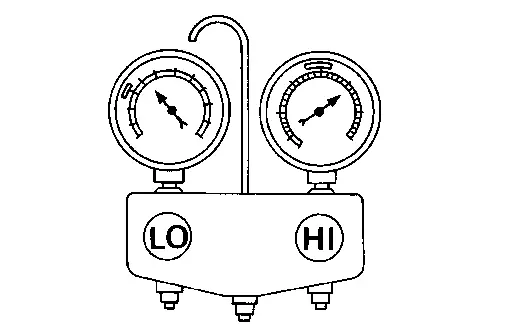
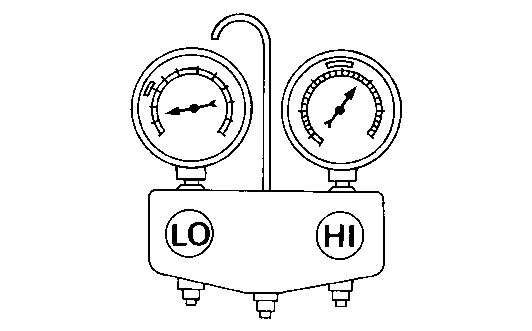
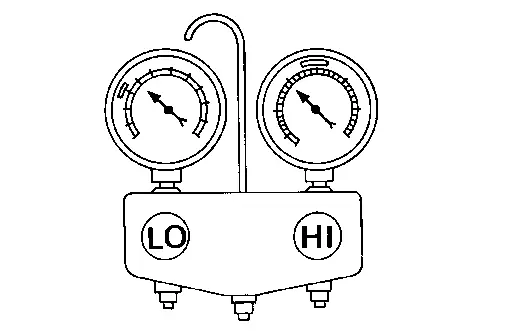
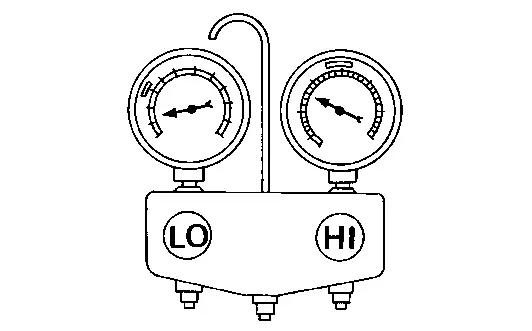
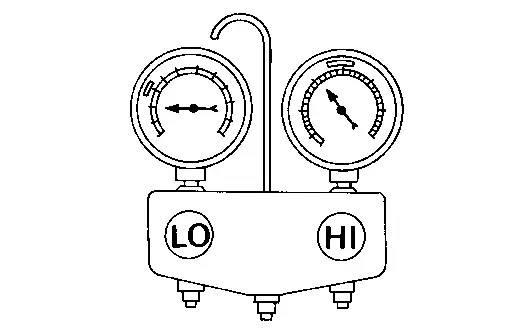
Diagnose using a manifold gauge whenever system’s high and/or low side pressure(s) is/are unusual. The marker above the gauge scale in the following tables indicates the standard (usual) pressure range. Refer to above table (Ambient air temperature-to-operating pressure table) since the standard (usual) pressure, however, differs from vehicle to vehicle.
Symptom Table
| Gauge indication | Refrigerant cycle | Probable cause | Corrective action |
|---|---|---|---|
|
Both high- and low-pressure sides are too high.
|
The pressure returns to normal soon after sprinkling water on condenser. | Overfilled refrigerant. | Collect all refrigerant, evacuate refrigerant cycle again, and then refill it with the specified amount of refrigerant. |
| Air flow to condenser is insufficient. |
Insufficient condenser cooling performance.
|
|
|
| When A/C compressor is stopped, a high-pressure reading quickly drops by approximately 196 kPa (2 kg/cm2, 28 psi). It then gradually decreases. | Air mixed in refrigerant cycle. | Collect all refrigerant, evacuate refrigerant cycle again, and then refill it with the specified amount of refrigerant. | |
|
Expansion valve opened too much (excessive flow of refrigerant). |
Replace expansion valve.
|
|
|
High-pressure side is excessively high and low-pressure side is too low.
|
High-pressure pipe and upper side of condenser become hot, however, liquid tank does not become so hot. | Clogged or crushed high-pressure pipe located between A/C compressor and condenser. | Repair or replace the malfunctioning parts. |
|
High-pressure side is too low and low-pressure side is too high.
|
|
Malfunction in A/C compressor system (insufficient A/C compressor pressure operation).
|
Replace A/C compressor. Refer to Removal and Installation. |
|
Both high- and low-pressure sides are too low.
|
|
Clogged expansion valve.
|
Eliminate foreign material from expansion valve, or replace it.
|
|
Malfunction in inner liquid tank (clogged strainer). | Replace condenser & liquid tank. Refer to Removal and Installation. | |
| Evaporator becomes frosted. | Clogged or crushed low-pressure pipe. | Repair or replace malfunctioning parts. | |
| Malfunction in intake air temperature sensor. | Check intake sensor system. Refer to Diagnosis Procedure. | ||
| There is a small temperature difference between the high and low pressure pipes for refrigerant cycle. |
|
|
|
|
Low-pressure side sometimes becomes negative.
|
|
|
|
| Hunting in high-pressure side. | There is no temperature difference between high- and low-pressure sides. | Malfunctioning variable valve in A/C compressor. |
|
Other materials
Cockpit
Example
The cockpit of the Nissan Armada is thoughtfully designed to provide intuitive
control, comfort, and accessibility for the driver. Every switch, button, and control
element is positioned to enhance driving convenience and ensure that essential functions
are always within easy reac ...
Calibration of Yaw Rate Sensor
Description
CAUTION:
Always perform the yaw rate sensor calibration before driving when the following operation is performed. Refer to Work Procedure.×: Required —: Not required Procedure Yaw rate sensor calibration
Removing/ installing ABS actuator and electric unit (control unit)
×
Rep ...
Front
Exploded View
Side defroster nozzle RH
Center defroster nozzle
Side defroster nozzle LH
Instrument panel assembly
Side ventilator grille LH
Instrument finisher A
Ionizer
(with ionizer models)
Side ventilator duct 1 LH
Side ventilator duct 3 LH
Side ventilator duct 2 L ...