Description
CONNECTION OF SERVICE TOOLS AND EQUIPMENT
Be certain to follow the manufacturer’s instructions for connecting to the machine.
Leak Test
CHECK REFRIGERANT LEAKAGE USING ELECTRICAL LEAK DETECTOR
WARNING:
Never check refrigerant leakage while the engine is running.
CAUTION:
Be careful of the following items so that inaccurate checks or misidentifications are avoided.
-
Never allow refrigerant vapor, shop chemical vapors, cigarette smoke, or others around the vehicle.
-
Always check refrigerant leakage in a low air flow environment so that refrigerant may not disperse when leakage occurs.
Stop the engine.
Connect recovery/recycling/recharging equipment or manifold gauge set to A/C service valve.
Check that A/C refrigerant pressure is 345 kPa (3.52 kg/cm2, 50 psi) or more when temperature is 16°C (61°F) or more. When pressure is lower than the specified value, recycle refrigerant completely and fill refrigerant to the specified level.
 NOTE:
NOTE:
Leakages may not be detected if A/C refrigerant pressure is 345 kPa (3.52 kg/cm2, 50 psi) or less when temperature is less than 16°C (61°F).
Clean area where refrigerant leakage check is performed, and check refrigerant leakage along all surfaces of pipe connections and A/C system components using electrical leak detector probe.
CAUTION:
-
Continue checking when a leakage is found. Always continue and complete checking along all pipe connections and A/C system components for additional leakage.
-
When a leakage is detected, clean leakage area using compressed air and check again.
-
When checking leakage of cooling unit inside, always clean inside of drain hose so that the probe surface may not be exposed to water or dirt.
NOTE:
-
Always check leakage starting from high-pressure side and continue to low-pressure side.
-
When checking leakage of cooling unit inside, operate blower fan motor for 15 minutes or more at the maximum fan speed while the engine is stopped, and then insert electrical leak detector probe into drain hose and hold for 10 minutes or more.
-
When disconnecting shut-off valve that is connected to A/C service valve, always evacuate remaining refrigerant so that misidentification can be avoided.
Repair or replace parts where refrigerant leakage is detected. (Leakage is detected but leakage area is unknown. GO TO 6.)
Start the engine and set A/C control in the following conditions.
-
A/C switch ON
-
Air flow: VENT (ventilation)
-
Intake door position: Recirculation
-
Temperature setting: Full cold
-
Fan (blower) speed: Maximum speed set
Run the engine at approximately 1,500 rpm for 2 minutes or more.
Stop the engine. Check again for refrigerant leakage. GO TO 4.
WARNING:
Be careful not to get burned when the engine is hot.
NOTE:
-
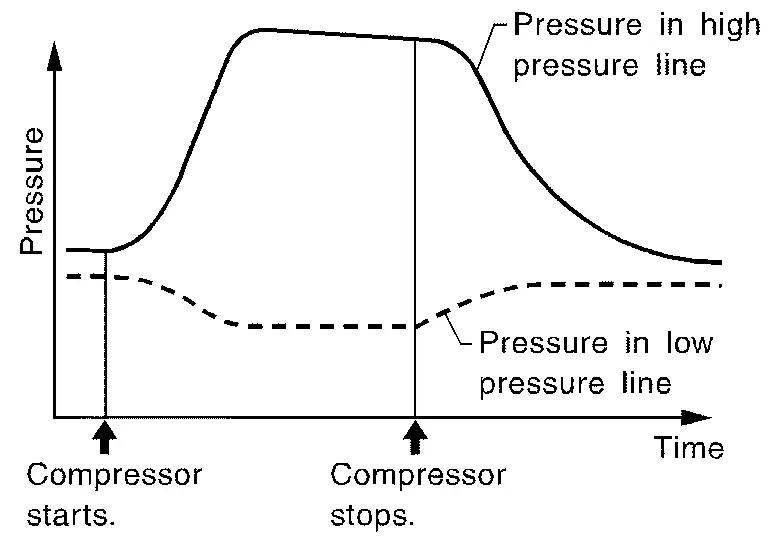
Start refrigerant leakage check immediately after the engine is stopped.
-
When refrigerant circulation is stopped, pressure on the low-pressure side rises gradually, and after this, pressure on the high-pressure side falls gradually.
-
The higher the pressure is, the easier it is to find the refrigerant leakage.
Recycle Refrigerant
WARNING:
-
Always use HFO-1234yf for A/C refrigerant. If CFC-12 or HFC-134a is accidentally charged, A/C compressor is damaged due to insufficient lubrication.
-
Always observe and follow precautions described on refrigerant container and service manual. Incorrect handling may result in an explosion of refrigerant container, frostbite, or the loss of eyesight.
-
Never breathe A/C refrigerant and lubricant vapor or mist. Exposure may irritate eyes, nose, or throat.
-
Never allow HFO-1234yf to be exposed to an open flame or others because it generates poisonous gas when in contact with high temperature objects. Keep workshop well ventilated.
-
Never place the refrigerant containers and recovery/recycling equipment in a place where the temperature exceeds 40°C (104°F).
-
Use a approved refrigerant recovery/recycling equipment (for HFO-1234yf).
Perform lubricant return operation. Refer to Perform Lubricant Return Operation. (If refrigerant or lubricant leakage is detected in a large amount, omit this step, and then GO TO 2.)
CAUTION:
Never perform lubricant return operation if a large amount of refrigerant or lubricant leakage is detected.
Check gauge pressure readings of recovery/recycling/recharging equipment. When remaining pressure exists, recycle refrigerant from high-pressure hose and low-pressure hose.
NOTE:
Follow manufacturer instructions for the handling or maintenance of the equipment. Never fill the equipment with non-specified refrigerant.
Remove A/C service valve cap from the vehicle.
Connect recovery/recycling/recharging equipment to A/C service valve.
Operate recovery/recycling/recharging equipment, and recycle refrigerant from the vehicle.
Evacuate air for 10 minutes or more to remove any remaining refrigerant integrated to compressor lubricant, etc.
Refrigerant recycle operation is complete.
Charge Refrigerant
WARNING:
-
Always use HFO-1234yf for A/C refrigerant. If CFC-12 or HFC-134a is accidentally charged, A/C compressor is damaged due to insufficient lubrication.
-
Always observe and follow precautions described on refrigerant container. Incorrect handling may result in an explosion of refrigerant container, frostbite, or the loss of eyesight.
-
Never breathe A/C refrigerant and lubricant vapor or mist. Exposure my irritate eyes, nose, or throat.
-
Never allow HFO-1234yf to be exposed to an open flame or others because it generates poisonous gas when in contact with high temperature objects. Keep workshop well ventilated.
-
Never place the refrigerant containers and recovery/recycling equipment in a place where the temperature exceeds 40°C (104°F).
-
Use a approved refrigerant recovery/recycling equipment (for HFO-1234yf).
Connect recovery/recycling/recharging equipment to the A/C service valve.
Operate recovery/recycling/recharging equipment, and evacuate air from A/C system for 25 minutes or more.
CAUTION:
Evacuate air for 15 minutes or more if the parts are replaced.
Check the airtightness of A/C system for 25 minutes or more. If pressure raises more than the specified level, charge A/C system with approximately 200 g (7.05 oz) refrigerant and check that there is no refrigerant leakage. Refer to Leak Test.
CAUTION:
Check the airtightness for 15 minutes or more if the parts are replaced.
If parts other than A/C compressor are replaced, fill compressor lubricant according to parts that are replaced.
Charge the specified amount of refrigerant to A/C system.
Check that A/C system operates normally.
Disconnect recovery/recycling/recharging equipment. (Collect the refrigerant from the high-pressure hose and low-pressure hose of recovery/recycling/recharging equipment.)
Install A/C service valve cap.
Refrigerant charge is complete.
Other materials
Overview
The Nissan Armada ProPILOT Assist system is an advanced driver assistance technology
designed specifically for controlled-access highways. It is not intended for urban
streets or rural roads. This system supports the driver by helping maintain lane
centering and keeping a preset following dist ...
System maintenance
If the AEB with Pedestrian Detection system in the Nissan Armada detects a malfunction,
it will automatically deactivate to prevent incorrect operation. In such cases,
an audible chime will sound, the AEB system OFF warning light (orange) will illuminate,
and the message "Malfunction See ...
Refrigeration System Symptoms
Trouble Diagnosis For Unusual Pressure
Diagnose using a manifold gauge whenever system’s high and/or low side pressure(s) is/are unusual. The marker above the gauge scale in the following tables indicates the standard (usual) pressure range. Refer to above table (Ambient air temperature-to-operati ...